
Something has shifted.
You can feel it in conversations at work. You can see it in the Facebook groups. More and more people are quietly asking the same question: do we actually need to get on a plane this year?
It’s not that anyone has gone off the idea of a holiday. Far from it. It’s that the calculation has changed. Flights that used to feel like a bargain don’t anymore. Airports that used to feel like the start of an adventure now feel like a stress test.
And somewhere along the way, a lot of people started looking at the UK differently – not as the backup plan, but as the actual plan.
They’re not alone. This year, searches for UK holidays are running at their highest levels since the post-Covid boom. Interest in caravan ownership hit a record high in March 2026 – already outpacing both August 2024 and August 2025.
People aren’t just thinking about UK holidays more. They’re thinking about them earlier, more seriously, and in bigger numbers than we’ve seen in years.
So what’s driving it? And what does it mean for how you plan your time away in 2026?
That’s exactly what we’re going to look at.
You don’t need to look far to see the shift happening.
The 2026 Caravan, Camping & Motorhome Show at the NEC Birmingham drew 100,072 visitors in February – a 12% rise on 2025 and the strongest February attendance the event has ever recorded. Coachman reported show sales up 20% year-on-year. The trade is reading the public mood correctly.
Research from holiday park operator Away Resorts showed that UK holidays have edged ahead of European breaks as the top choice for British families – 46% versus 45%. A margin thin enough to feel like a coin flip, but a telling one.
Then there’s the search data. In January 2026, searches for ‘UK holiday 2026’ were running at over 27,000 a month – up more than 4,000% year-on-year. That’s not a blip. That’s a fundamental change in when and how people are planning their time away.
Regional interest is spiking too: data from Schofields Insurance shows UK holiday cottage searches up 260% in early March 2026, with the Lake District up 129% year-on-year, the Cotswolds up 128%, and Cornwall up 46%.
The caravan market is telling the same story.
Google Trends data for ‘caravans for sale’ reached a score of 40 in March 2026 – higher than the August peaks of both 2024 (37) and 2025 (33), and the month isn’t finished yet.
Searches for ‘caravan holiday UK’ hit 22,200 in January 2026 – a 174% jump in a single month, and the highest January figure since the post-Covid surge. Searches for ‘caravans for sale’ climbed to 49,500 in January before the spring peak had even arrived. Historically, that kind of volume didn’t show up until April or May.
Here’s what makes 2026 different from previous years: people aren’t just searching more – they’re searching earlier. The buying cycle has shifted forward by roughly two months.
Whatever is driving UK holiday intent, it’s hitting harder, and sooner, than it used to.
Over 27,000 searches for ‘UK holiday 2026’ in a single month. A record March peak for caravan interest – in early Spring.
Something has changed.
It’s not one thing. It’s several things arriving at the same time.
The idea of cheap European flights is still out there – but the reality has shifted significantly. Since 2022, average airfare on short-haul European routes has climbed sharply.
Add baggage fees, transfers, airport parking, and the cost of actually getting to and from the airport, and a supposedly budget trip can quietly double before you’ve left the country.
For a family of four, that maths starts to sting. A lot of people are doing the sums properly for the first time – and finding that a UK holiday, once you strip away the airport theatre, can work out cheaper than they expected.
The last few years have reminded a lot of people that booking a holiday abroad means taking on risks you can’t always plan for. Flight disruption. Strikes. Health emergencies. Geopolitical instability. Even just the rising cost of travel insurance.
None of these things are new. But they’ve become more visible – and more frequent. A 2022 survey by Mintel found that around three-quarters of British travellers expected to experience some form of travel disruption on a foreign trip. That’s a significant number of people quietly factoring in the hassle tax.
Staying in the UK removes most of that. You can leave when you want, change your plans if something comes up, and not spend the first day of your holiday worrying whether your bags made the connection.
This one doesn’t get said enough.
The UK is a remarkable place to travel. The King Charles III England Coast Path – at over 2,700 miles, the longest coastal walking route in the world – is still opening new sections.
National parks from the Cairngorms to the Brecon Beacons offer landscapes that rival anything you’d pay to fly to. And the food, hospitality, and accommodation have improved significantly over the past decade.
The ‘UK holiday as consolation prize’ idea is outdated. For a lot of people in 2026, it’s the actual first choice – not the fallback.
The search volume tells you people want a UK holiday. It doesn’t tell you what kind.
When you look past the headline numbers and into the research on what British holidaymakers actually want in 2026, a clear picture starts to form. And it’s one that should feel familiar.
People want to slow down.
A 2026 Away Resorts survey found that nearly seven in ten UK holidaymakers said their top priority was a relaxed, stress-free break. Not the most Instagrammable destination. Not the best nightlife. Just somewhere they could properly switch off.
More than six in ten said they wanted somewhere that felt like a home away from home. Comfortable. Familiar. Their own space, on their own schedule.
Family time came up again and again – not as a nice-to-have, but as the main point of the trip. The chance to be together without the noise of day-to-day life getting in the way. No school runs, no commutes, no packed itineraries. Just time.
And then there are the dogs.
It’s easy to underestimate how much the pet factor shapes holiday decisions for British families. Around 17 million households in the UK own a dog.
For many of them, finding accommodation that genuinely welcomes pets – not just tolerates them – is a deciding factor. European holidays make that hard. A UK trip with your own touring caravan makes it a non-issue.
There’s also a broader shift happening in how people think about travel itself. The rush to tick off destinations, collect stamps, and squeeze in as much as possible is fading for a lot of people.
What’s replacing it is something quieter – a preference for fewer places, experienced more fully. A walk along a coastal path. A long evening around a camp kitchen. Waking up somewhere new without having set an alarm to catch a flight.
That’s not a compromise. That’s actually what a lot of people want.

Everything we’ve covered so far points in the same direction.
People want UK holidays. They want flexibility. They want their own space, their own schedule, and somewhere their dog is genuinely welcome. They want to slow down – not squeeze in.
And they want to do it without the stress of airports, the unpredictability of foreign travel, or the cost of accommodation that adds up faster than the holiday brochure suggests.
A touring caravan delivers all of that. In one purchase. That’s not a sales pitch. It’s just the logic of the thing, laid out plainly.
Your accommodation goes with you. There’s no booking windows to navigate, no availability calendars to fight with in peak season, no nightly rate that triples because it’s a bank holiday weekend. You decide where you go. You decide when. You can leave on a Tuesday if the weather looks good and be somewhere on the Jurassic Coast by Thursday afternoon.
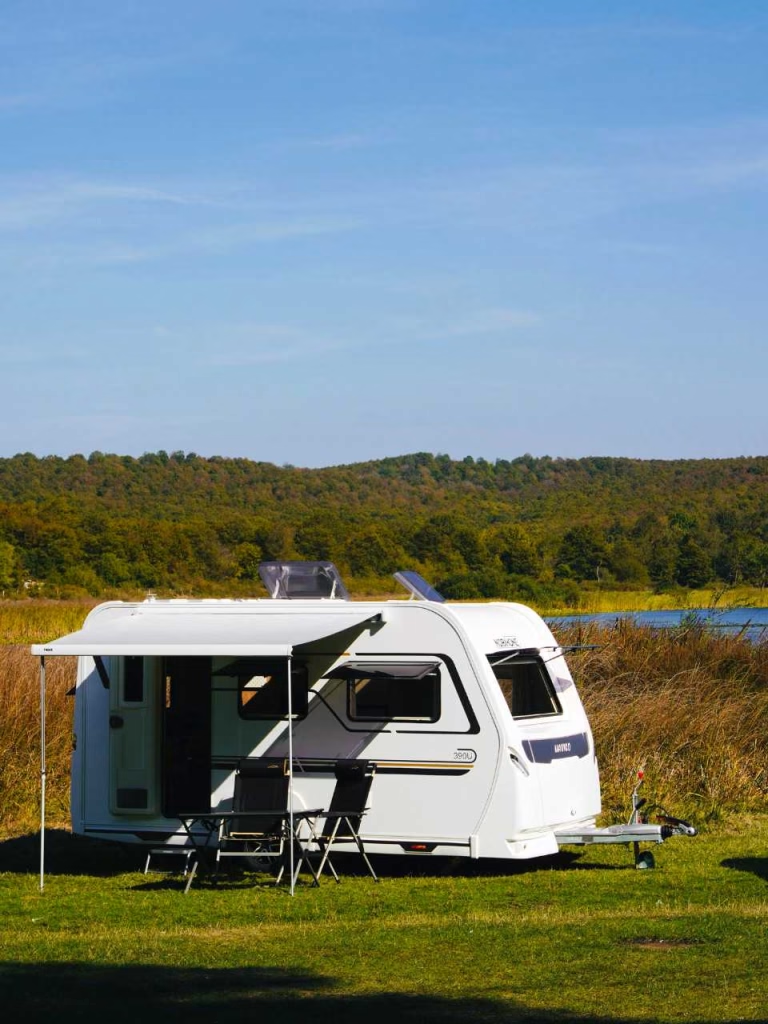
You’re not compromising on comfort. The touring caravans available in 2026 are a long way from the caravans people remember from childhood holidays. Modern Bailey and Coachman models come with full kitchens, proper beds, efficient heating, and interiors that feel like a thoughtfully designed living space rather than a box on wheels.
If you haven’t looked at what’s available recently, the step change in quality will surprise you.
The dog comes too. No kennels. No guilt. No negotiating with a pet-unfriendly rental. Your dog is part of the trip – which, for the millions of UK households with a dog, is worth more than it might sound.
The costs make sense long-term. Yes, there’s an upfront purchase. We’ll cover the numbers properly in the next section. But once you own a caravan, your accommodation cost for every subsequent trip drops dramatically.
For families who holiday more than once a year – or who want to – the maths shifts in your favour faster than most people expect.
And then there’s the less tangible stuff.
The feeling of waking up somewhere new without having set an alarm. The fact that your holiday starts the moment you leave the driveway, not when you finally clear security. The slow evenings, the flexible mornings, the ability to change your plans on a whim without losing a non-refundable deposit.
That’s what a touring caravan gives you. Not just a vehicle. A different way of doing holidays entirely.
Let’s be honest about this from the start.
Buying a touring caravan is not a small purchase. A new entry-level model from a brand like Bailey or Coachman will typically start somewhere around £15,000–£18,000. Mid-range models with more space and better spec sit in the £20,000–£30,000 range. If you’re looking at something higher-end, you can go further.
That’s real money. It deserves a straight answer, not a brushed-over comparison.
Think about what a week-long European holiday costs a family of four in 2026. Return flights – even on a budget airline, once you’ve added bags – are rarely under £600–£800. Airport transfers, car hire, or both, add another £200–£400.
Accommodation for seven nights in a decent apartment or hotel: £800–£1,500 depending on destination and time of year. Food, drinks, and activities on top.
A modest estimate puts a one-week European family holiday at £2,500–£4,000. A decent one sits closer to £4,000–£6,000.
| European holiday (family of 4) | UK caravan holiday | |
|---|---|---|
| Flights | £600–£800 | — |
| Transfers/car hire | £200–£400 | — |
| Accommodation (7 nights) | £800–£1,500 | £175–£350 (site fees) |
| Food | £400–£600 | Similar to home |
| Estimated total | £2,500–£4,000 | £600–£700 |
Now think about a UK caravan holiday for the same family. Site fees at a well-run UK campsite typically run between £25–£50 per night. A week on site costs £175–£350. Food costs are broadly the same as at home – you’re cooking in your own kitchen.
Fuel is a real cost, but a week touring the Lake District or the Pembrokeshire coast isn’t hundreds of miles from most of the UK.
All in, a week’s UK caravan holiday for a family of four can comfortably come in under £600–£700. Some will spend more. Many will spend less.
Here’s where the maths gets interesting.
If you spend £25,000 on a touring caravan and holiday in it twice a year – saving roughly £3,000 per trip compared to a European holiday – you’ve recouped the purchase cost in about four years.
And that’s before you factor in that a well-maintained caravan holds its value reasonably well, and that you could choose to sell it further down the line.
It’s not a guaranteed calculation – costs vary, trips vary, and a caravan does come with ongoing expenses like storage, insurance, and annual servicing.
But the principle holds: for families who holiday regularly, caravan ownership is not just a lifestyle choice. It’s a financially sensible one over the medium term.
If the upfront cost is the sticking point, you don’t necessarily need to find the full purchase price in one go.
At Raymond James Caravans, we work with a range of lenders who offer caravan finance options – meaning you could be out on the road for a manageable monthly payment rather than a large one-off outlay.
It’s worth having a conversation about what’s possible before you assume it’s out of reach.
Find out more about caravan finance at Raymond James Caravans →
More Brits are choosing UK holidays in 2026 for three main reasons.
A touring caravan combines all three advantages: lower ongoing holiday costs, complete flexibility, and access to the best of the UK on your own terms.

For most families, yes – once you account for the full cost of a foreign trip. Return flights for four people, baggage, transfers, and accommodation abroad can easily reach £3,000–£6,000 for a week.
A UK caravan holiday can bring that same week in under £700, with site fees typically running £25–£50 per night. The upfront cost of buying a touring caravan is real, but for families who holiday more than once a year, the maths shifts in your favour faster than most people expect.
Wales is consistently one of the most searched-for UK caravan destinations – with the Pembrokeshire Coast and Snowdonia both offering outstanding scenery and well-run campsites.
Dorset and the Jurassic Coast are popular in the south, with a strong mix of coastal sites and easy access to attractions. The Lake District, Yorkshire Dales, and the Scottish Highlands round out the most-visited regions.
The advantage of touring is that you’re not locked into one – you can move on when you’re ready.
Three things are driving it: cost, uncertainty, and quality. Foreign travel has become noticeably more expensive and less predictable.
At the same time, the UK has genuinely improved as a holiday destination – better facilities, more dog-friendly options, and world-class landscapes that don’t require a passport.
Search interest in ‘caravans for sale’ hit a record March 2026 high, outpacing the August peaks of both 2024 and 2025, with the month not yet finished.
It’s one of the most practical ones. You take your accommodation with you, so there are no availability windows to fight, no nightly rates that spike at peak times, and no kennels for the dog.
Modern touring caravans from brands like Bailey and Coachman are a long way from the caravans people remember from childhood – comfortable layouts, proper kitchens, and efficient heating are standard across the range.
If you’re exploring the idea, it’s worth coming in to see what’s available and having a chat with the team at Raymond James Caravans.
The shift is already happening. More Brits are choosing UK holidays in 2026 than we’ve seen in years – and the smart ones are already thinking about how to make the most of it.
A touring caravan gives you the freedom to go where you want, when you want, on your own terms. No airports. No availability windows. No compromise.
If you’re curious about what’s available – whether you’re ready to buy or just starting to look – come and have a chat with the team at Raymond James Caravans. There’s no pressure. Just honest advice from people who know their stuff.